
Baltimore County Arrest Records and Court Charges
Baltimore County arrest records start with the law-enforcement side of an event. The Baltimore County Police Department is the local source for police incident and report requests, while the Department of Corrections handles custody checks after a person is booked into the county detention center. Those arrest-side records are not the same as the charge list in a court case. A charge record identifies the criminal or traffic allegation filed with the court, the case number, the court location, the trial date if one is set, the bail or bond entry when shown, and the current disposition.
After an arrest, Maryland court charges can appear in a statement of charges, criminal complaint, information, or indictment. Baltimore County cases may begin in District Court for misdemeanors, traffic offenses, and some felony matters, while serious felonies and jury-trial cases move to the Circuit Court. The Baltimore County State's Attorney reviews and prosecutes felony, misdemeanor, and juvenile cases that occur in the county. The full case file, including pleas, motions, sentencing, and post-judgment events, belongs with Baltimore County criminal court records; the custody and booking path belongs with the jail and inmate channels.
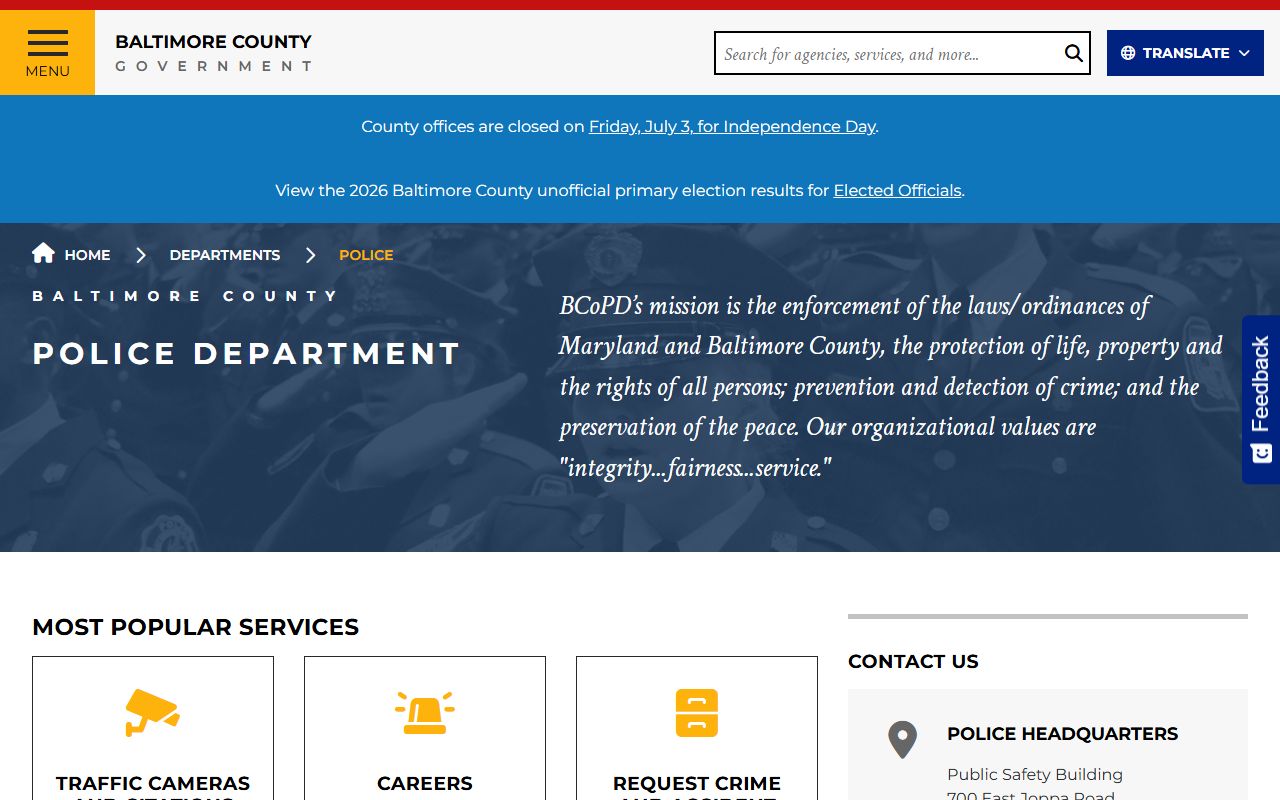
The Baltimore County Police Department page is an official lead-in for arrest-side records.
Find Baltimore County Arrest Records and Charges
Start with the record type. For charges filed in court, use Maryland Judiciary Case Search, which provides public summary information for Maryland District Court and Circuit Court cases. Search by defendant name or case number, then narrow by Baltimore County, court, case type, or filing date when the form offers those fields. For the police report connected to an arrest, use the Baltimore County Police report request process. For current custody, use the Department of Corrections hotline, VINELink, or the state locator when a person has moved into state custody.
- Open Maryland Judiciary Case Search and choose a name or case-number search.
- Filter to Baltimore County when the form offers a county or court filter.
- Open a matching criminal or traffic case and review the charge wording, charge count, court, date, bail entry, and disposition.
- If the online summary is missing or suppressed, contact the Clerk of the Circuit Court Judicial Records line at 410-887-3494 or the District Court location that heard the case.
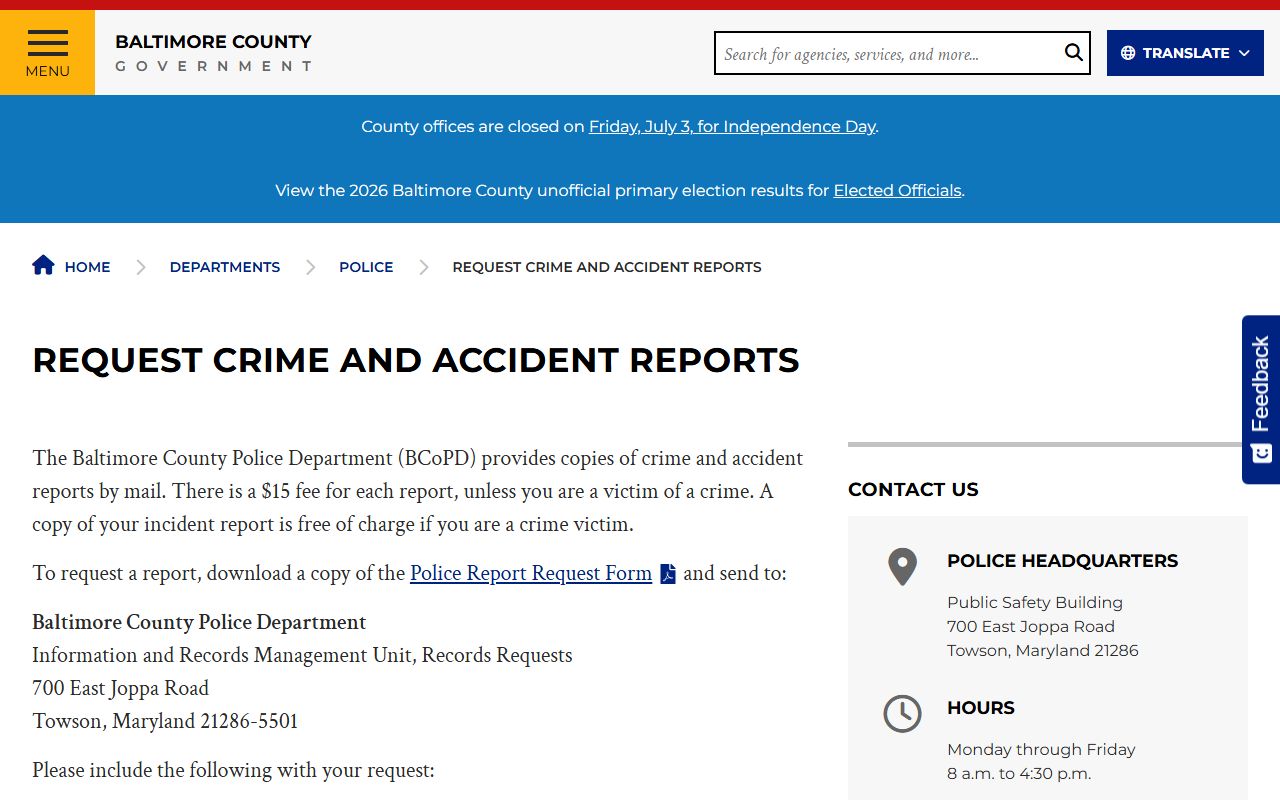
- For the arrest report, use the police request form and route the request to the Information and Records Management Unit.
The Baltimore County police report request page is the official access channel for local police reports.
Baltimore County Court Charges After Arrest
Court charges after arrest are created through a charging document. Maryland records may use a statement of charges at the beginning of a case, an information filed by the State's Attorney, or an indictment returned by a grand jury. Each form can lead to a public docket entry, but it does not prove guilt. It is the formal accusation that starts or advances the court case.
| Document | Who Uses It | How It Functions | Where It Appears |
|---|---|---|---|
| Statement of charges | Judicial officer or charging agency | Often starts a Maryland criminal case after arrest or application. | District Court or transferred case record. |
| Information | State's Attorney | Prosecutor-filed charge document used after review. | Circuit Court or District Court case file. |
| Indictment | Grand jury | Formal felony charge returned by a grand jury. | Usually Circuit Court criminal docket. |
One arrest can produce several charge counts. The record may show a statute reference, a short charge phrase, a severity level, and a disposition for each count. If a charge is amended, reduced, dropped, or merged, the docket may keep both the original allegation and the later event. That is why a charge record should be read with the docket history, not as a single static line.
Baltimore County Charge Review
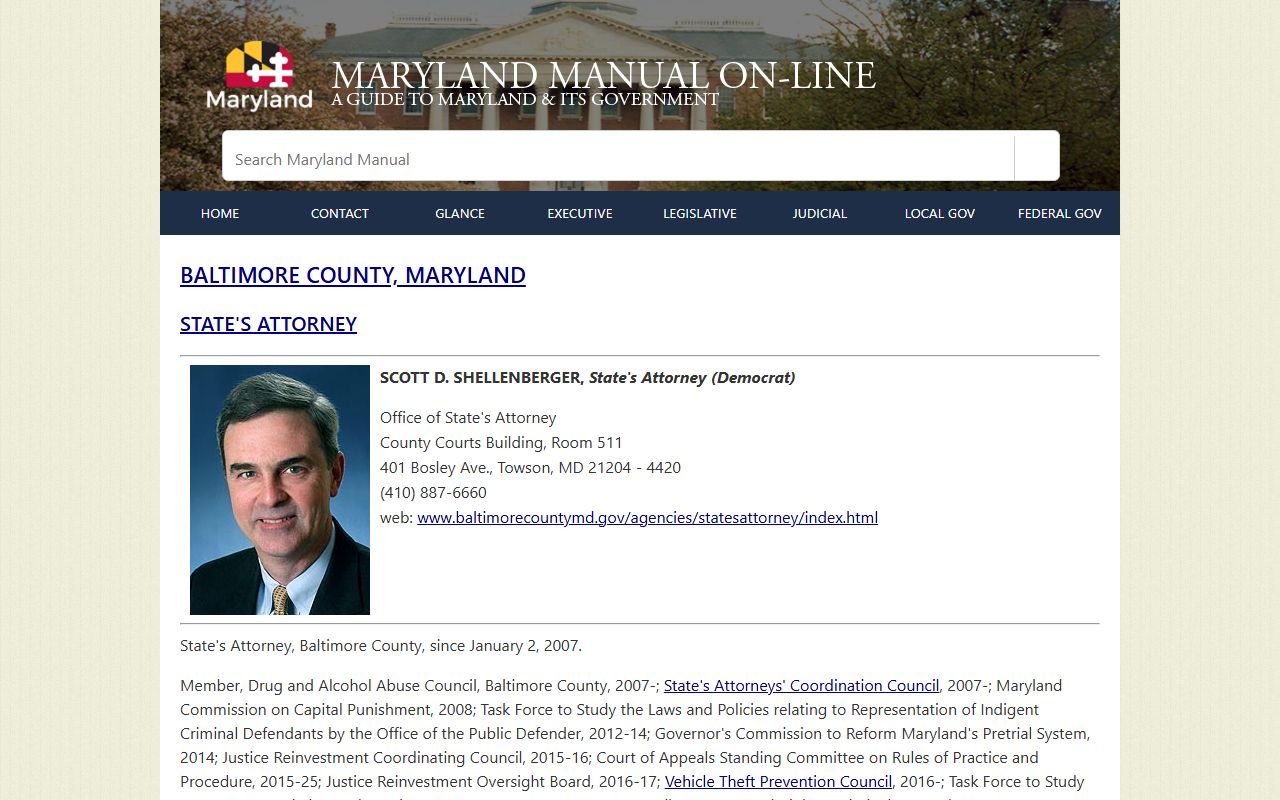
Maryland uses the term State's Attorney for the prosecutor. The Baltimore County State's Attorney prosecutes felony, misdemeanor, and juvenile cases that occur in the county. The office is led by Scott D. Shellenberger and is located in the County Courts Building at 401 Bosley Avenue, Room 511, Towson, MD 21204. Main reception is 410-887-6600, and official county material lists statesattorney@baltimorecountymd.gov for office email.
The State's Attorney may proceed on the original charge, amend the wording, reduce a count, dismiss a count, or enter nolle prosequi. Nolle prosequi means the prosecutor has chosen not to pursue that charge. It is not a conviction. A later docket line may also show probation before judgment, stet, guilty, not guilty, or dismissal, depending on the case path and the court's ruling.
The Maryland Manual State's Attorney profile is the manifest source for the prosecutor image assigned to Baltimore County court charges.
Baltimore County Charge Status
A Baltimore County charge record should be read count by count. A case can have a guilty disposition on one charge, nolle prosequi on another, and dismissal or merger on a third. Case Search may also suppress some outcomes from remote display under Maryland rules, including certain dismissed, acquitted, nolle prosequi, stet, and cannabis-related records. If the public online record is incomplete, the clerk or the court location is the proper fallback.
| Status | What It Means | Record Caution |
|---|---|---|
| Pending | The charge has not reached final disposition. | Check for the next hearing date and any bond event. |
| Amended or reduced | The prosecutor or court changed the charge wording or severity. | Read the docket to see both the old and new count. |
| Dismissed or not guilty | The charge did not end in a conviction. | Do not treat the arrest or charge as proof of guilt. |
| Nolle prosequi | The State's Attorney chose not to pursue the charge. | Remote display may be limited by Maryland suppression rules. |
| Guilty or PBJ | The case ended with a guilty finding, plea, or probation before judgment. | Sentence, probation, fines, or conditions may appear later in the docket. |
Baltimore County Charges vs Convictions
An arrest record, a charge, and a conviction are three different points in the process. The arrest records the enforcement event. The charge is the formal allegation filed in court. A conviction only exists after a guilty plea, guilty verdict, or other qualifying outcome. Baltimore County Case Search summaries may show all three kinds of information near each other, so the disposition field matters.
| Point in Process | Charge | Conviction |
|---|---|---|
| Meaning | An accusation filed after arrest or charging review. | A final guilty outcome or plea recorded by the court. |
| Proof level | Based on probable cause or charging decision. | Based on plea or proof beyond a reasonable doubt. |
| Where to verify | Charging document and docket entries. | Disposition, plea, verdict, and sentence entries. |
| Common error | Treating every filed count as true. | Ignoring dismissed or nolle prosequi counts in the same case. |
Baltimore County Arrest Report Requests
Police reports are requested from Baltimore County Police, not from the Clerk of the Circuit Court. The accessible research identifies the official police report request form as a mail-in record request channel. That form asks for the case number if known, the date and location of the incident, the names of involved parties, the requester's contact information, and payment. If the goal is the filed court charge, search court records first. If the goal is the incident report, use the police report path.
The Baltimore County police report request form is the documented form channel for arrest-side report requests.
Note: A police report can be withheld or redacted when an investigation, juvenile matter, privacy rule, or public-safety limit applies.
Baltimore County Arrest Records Access Rules
Maryland court access is layered. Judicial records are governed primarily by Maryland Rules 16-901 through 16-912, while local police records are often requested under the Maryland Public Information Act. Court summaries may be public even when a full document, personal identifier, juvenile file, or sealed record is not. Full court documents may require a clerk request, courthouse kiosk, or authorized MDEC access.
Expungement and shielding also affect public display. Maryland Criminal Procedure Section 10-105 covers many expungement paths, and Section 10-110 addresses shielding for certain eligible convictions. The Baltimore County Clerk's Office lists an expungement line at 410-887-3090. If a case was in District Court, that District Court location handles the filing. If it was in Circuit Court, the Clerk of the Circuit Court handles it.
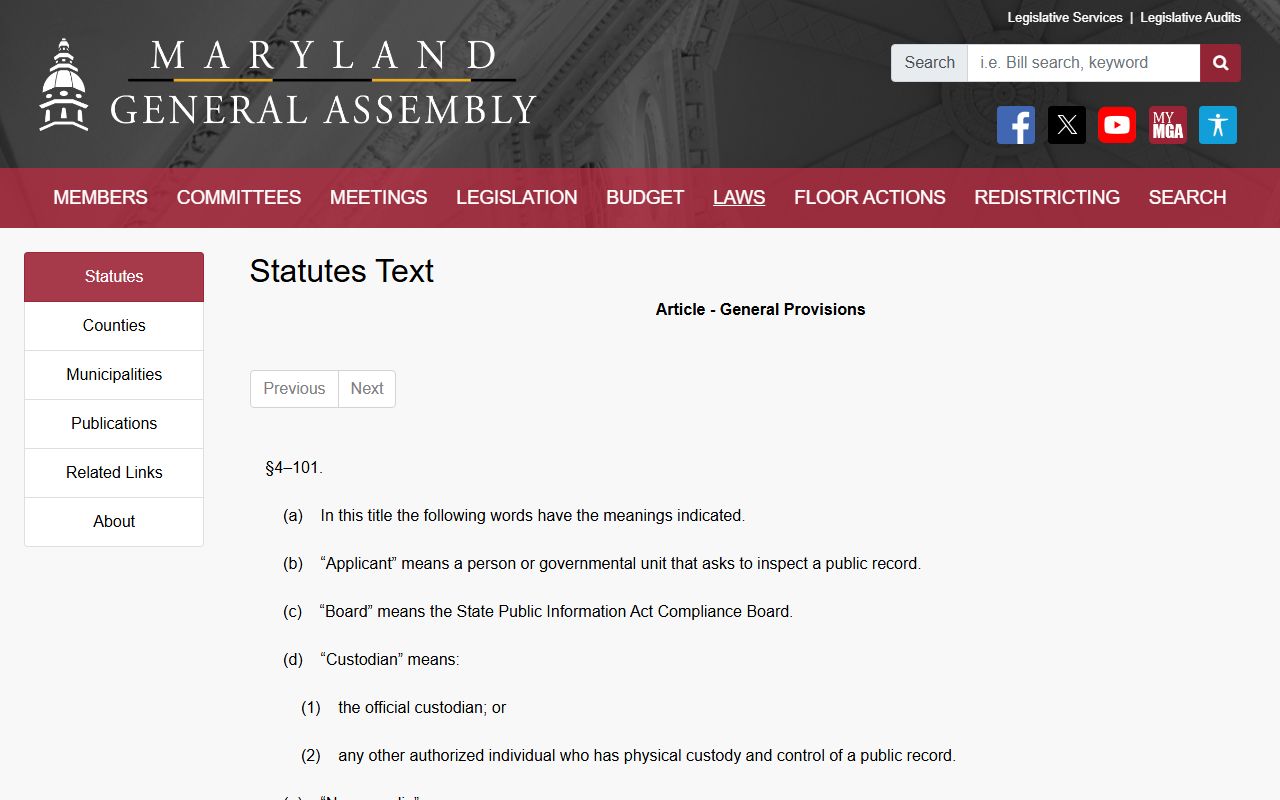
The Maryland Public Information Act statute is the source for the access-law image assigned to Baltimore County arrest records.
Restricted Baltimore County Charge Records
Not every charge or arrest detail is public. Juvenile delinquency, child welfare, sealed warrants, sealed documents, expunged cases, family financial records, medical information, Social Security numbers, and some protective-order material are restricted under Maryland access rules. Search warrants and arrest warrants may also be restricted before execution or while sealed. A missing online result can mean no case, but it can also mean the case is suppressed from remote viewing or belongs in another official system.
For representation issues, the Maryland Office of the Public Defender Baltimore County office handles local public-defense contact after eligibility is determined. The Judiciary public-defender process says a District Court Commissioner determines eligibility for criminal or traffic cases carrying possible incarceration. Applicants may need charging documents, trial-date notices, pay stubs, or proof of public assistance.